Custom Jewelry Magnetic Drawer Boxes turn a small object into a carefully staged reveal. A customer slides the drawer open, sees a soft insert, and notices whether the box feels precise or flimsy. That moment matters, but packaging must also protect delicate pieces during storage and delivery.
Grand View Research estimated the global jewelry market at USD 353.26 billion in 2023 and projected a 4.7% compound annual growth rate from 2024 to 2030. This figure describes jewelry, not jewelry packaging. It signals the scale of the market, while leaving a practical question for brands: how can packaging communicate value without adding unnecessary bulk? A rigid drawer, secure magnetic closure, and correctly sized insert offer a clear starting point. Small details count.
For manufacturers in China, customization involves more than choosing a color. Board thickness, drawer clearance, ribbon placement, surface finish, and insert fit all affect the unboxing experience. Yet a polished sample does not guarantee consistent mass production. That deserves attention. I cannot responsibly attribute a verbatim statement on this niche product to a named expert without a verifiable source. Instead, this outline will assess materials, structure, customization, quality checks, and supplier selection using practical criteria. The market figure provides context, not proof that one box design will succeed. Brands should test samples with their actual jewelry before approving an order.
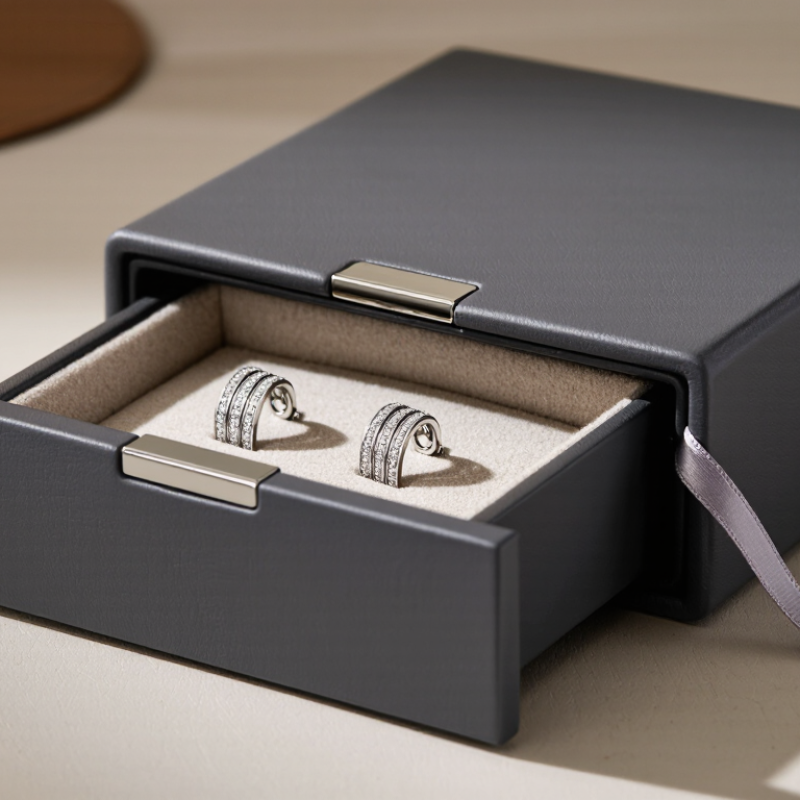
China’s custom jewelry magnetic drawer boxes combine a rigid outer sleeve with a sliding inner tray. The magnetic closure gives a clean click, while a ribbon pull helps lift the tray without touching the jewelry. Buyers can specify board thickness, paper texture, foam inserts, and compartment size. Fit matters. A ring box needs a different insert from a pendant box, and small gaps can make a premium package feel careless.
Smithers’ The Future of Packaging: Long-Term Strategic Forecasts to 2030 estimated the global packaging market at about US$1.05 trillion in 2024. This broad figure does not isolate jewelry boxes, but it shows the scale of packaging demand behind China’s supplier base.
For custom orders, request a physical sample and check drawer resistance, magnet alignment, print color, and edge finishing. Ask for material and production specifications, too.
Recycled paper options may reduce virgin-fiber use, though coatings and laminated finishes can complicate recycling. A polished sample can still hide batch variation. That risk deserves attention, especially when box dimensions must match delicate pieces.
A magnetic drawer box uses two coordinated parts: a rigid outer sleeve and a sliding inner tray. Small magnets sit inside the sleeve’s front panel and the tray’s matching edge, holding the box closed without a visible clasp. A paper pull tab or fabric ribbon gives fingers room to open it. Keep the tray’s side clearance consistent; a few millimeters of error can make it scrape or wobble. The fit matters.
For jewelry, the insert should steady the piece rather than merely look polished. A velvet-covered pad, shaped recess, or elastic loop can limit movement during handling. Test the box with the actual item: a pendant’s chain may catch, and a ring can shift if its slot is too wide. The U.S. Environmental Protection Agency’s Advancing Sustainable Materials Management: 2018 Fact Sheet reports that containers and packaging made up 28.1% of U.S. municipal solid waste generated that year. That figure is not specific to jewelry, but it is a useful reminder to avoid unnecessary layers and oversized trays. Strong magnets can improve closure, yet excess force may make a slim drawer awkward to open. Not perfect. Prototype the structure with the intended board, insert, and product before approving production.
A magnetic drawer box typically combines an outer sleeve, a sliding inner tray, and magnets that help keep the box closed. The chart compares calculated tray capacity for three sample internal sizes. Capacities are calculated from length × width × height; these are illustrative design examples, not standardized sizes or product test results.
Custom jewelry magnetic drawer boxes depend on more than appearance. The outer wrap, rigid board, drawer fit, and insert all affect protection and presentation. Many projects use paper-wrapped greyboard, while specialty papers or fabric can create a softer, more tactile feel. Board thickness should suit the jewelry’s weight and the box dimensions. A drawer that feels smooth when empty may bind once the insert is fitted.
Finishes shape both look and handling. Matte lamination reduces glare and resists light scuffs, while gloss makes colors appear brighter but can show fingerprints. Soft-touch coatings feel pleasant, though they may mark during frequent handling. Foil stamping, embossing, and spot UV can highlight small design areas without covering every surface. Small details matter. Ask for a physical sample, since colors and textures can look different on screen.
Customization can include drawer depth, pull tabs, magnetic closure strength, insert material, and compartment layout. Foam, paperboard, or covered flocked inserts suit different pieces; thin chains need restraint or separate channels to prevent tangling. Keep the magnet secure but easy to open, especially for compact boxes. Test a sample. It is easy to overlook how an insert changes the drawer clearance, and a slightly tight fit may become frustrating in daily use.
Custom jewelry magnetic drawer boxes start with the product’s dimensions, weight, and storage needs. A sample helps confirm the drawer slides smoothly and the lid closes evenly. Makers select board thickness, wrapping paper, and insert materials to suit the design. They also check magnet polarity and placement before assembly. Small details matter. A magnet that is too strong can make opening the box awkward.
During production, operators inspect cut edges, folded corners, and glued seams. They compare printed colors with an approved sample, since screen previews can differ from finished paper. Quality checks can include measuring the box, opening and closing the drawer repeatedly, and checking whether the insert holds jewelry securely. A light pull test may reveal a loose magnet. Still, one sample cannot represent every box in a large run, so periodic checks are important. Minor variation can occur, and clear tolerances help teams decide what needs correction.
Tips: Ask for a pre-production sample, confirm the insert dimensions, and test the drawer with the intended jewelry inside. Check the packaging after it has rested; adhesive and wrapped edges may settle slightly over time.
| Manufacturing Stage | Key Operations | Quality Control Check | Acceptance Basis | Typical Record |
|---|---|---|---|---|
| 1. Specification Review | Confirm box dimensions, board construction, paper or fabric finish, drawer layout, magnet positions, insert design, artwork, and packing requirements. | Review the approved drawing, material specifications, artwork files, and any required physical reference sample before production. | All production details must match the approved specifications; unresolved details are clarified before material preparation. | Approved drawing, material list, artwork proof, and sample approval record. |
| 2. Material Inspection | Check rigid board, covering material, adhesive, magnets, insert materials, and protective packaging upon receipt. | Inspect material identity, visible damage, contamination, color, and dimensions against the purchase and product specifications. | Materials must be the specified type and suitable for the approved box construction; defects are segregated for review. | Incoming inspection log and material batch identification. |
| 3. Board Cutting and Preparation | Cut and prepare the rigid-board panels for the outer case, drawer, and other structural components. | Measure panel dimensions and inspect cut edges, squareness, and surface condition. | Dimensions and construction follow the approved drawing and stated tolerances; cut edges are free from damage that affects assembly. | First-piece measurement and in-process inspection record. |
| 4. Covering and Wrapping | Apply the selected paper or fabric to the board, including corners, edges, and folded areas. | Check alignment, surface appearance, edge coverage, bubbles, wrinkles, stains, and exposed board. | Finish must match the approved sample and appearance requirements; visible defects affecting the finished presentation are not accepted. | Visual inspection record and approved color reference. |
| 5. Drawer and Insert Assembly | Assemble the drawer and fit the jewelry insert, lining, or compartments according to the approved design. | Check drawer dimensions, insert placement, adhesive condition, and whether the intended jewelry item fits securely. | Drawer and insert must fit the approved design without obstructing normal opening or closing; fit is verified using the specified product or gauge. | Assembly check and fit-test result. |
| 6. Magnet Installation | Install the specified magnets in the planned positions in the box structure. | Check magnet position, polarity where applicable, bonding, alignment, and closure function. | The closure must engage as designed, remain aligned, and open without damage during repeated functional checks defined in the inspection plan. | Magnet placement check and closure test record. |
| 7. Printing and Decoration | Apply approved printing, foil stamping, embossing, debossing, or other specified decoration. | Compare text, artwork, position, color, and finish with the approved proof or reference sample. | Decoration must be legible, correctly positioned, and consistent with the approved artwork; no unintended marks or missing elements. | Artwork approval and decoration inspection record. |
| 8. Final Assembly and Inspection | Complete assembly, clean the box, and inspect the finished product before packing. | Check overall dimensions, structure, surface finish, drawer movement, magnetic closure, insert fit, and visible cleanliness. | Finished boxes must meet the approved specification and sample. Any dimensional tolerance or cosmetic grading rule should be defined in the product inspection plan. | Final inspection checklist and nonconformance record, if applicable. |
| 9. Packing and Dispatch Preparation | Protect finished boxes with the specified inner packing and outer cartons; label and prepare the shipment. | Verify quantity, packing method, carton condition, labels, and protection against movement or abrasion. | Packing must follow the approved packing instructions and protect the boxes during normal handling and transportation. | Packing list, carton check, and shipment release record. |
| Quality note: Inspection limits, sample sizes, and dimensional tolerances should be agreed in the product specification before production. Where a sampling plan is used, it can be selected and documented with reference to ISO 2859-1; the applicable inspection level and acceptance criteria should be stated for each order. | ||||
A reliable China-based manufacturer should show more than polished product photos. Request a physical sample of the magnetic drawer box and inspect its paper wrap, corners, drawer movement, and magnet alignment. Ask how the supplier controls board thickness, color matching, and assembly across repeat orders. A smooth sample matters. So does a documented production process. Request a factory audit or a live production walkthrough, and confirm who handles quality checks before shipment. If communication is vague during sampling, expect more questions later.
Scale and material choices deserve attention. Smithers’ report, The Future of Global Packaging to 2028, projects the global packaging market will reach about US$1.2 trillion by 2028. That growth makes supplier capability and consistency important, not guaranteed. Compare quotations by checking what they include: rigid board, printed paper, inserts, sampling, packing, and shipping terms. Ask for material specifications and test whether the drawer still opens cleanly after the box is wrapped. Small details can slip. I would also verify production lead times against a written schedule; forecasts sometimes prove optimistic.
Tips: Send artwork, dimensions, order quantity, and insert requirements together. Request a pre-production sample, confirm inspection criteria in writing, and keep one approved sample as your reference. Ask how defects are recorded and corrected. A low price is not a quality plan.
Small magnets inside the sleeve and tray hold the box shut. A paper tab or fabric ribbon helps you pull the tray open. No visible clasp is needed.
A few millimeters can change how the tray moves. Too little clearance may cause scraping; too much can make it wobble. Fit matters.
It should steady the piece, not just look polished. Use a shaped recess for a ring or a loop for a pendant. Test with the actual jewelry.
Give thin chains separate channels or another form of restraint. Check that the chain does not catch when the tray slides. Test it.
Paper-wrapped greyboard is a common structure. Specialty paper or fabric can add texture. Choose board thickness to suit the box size and jewelry weight.
Matte lamination reduces glare and resists light scuffs. Gloss can brighten colors but may show fingerprints. Soft-touch coatings feel pleasant, yet can mark with handling.
Options include drawer depth, pull tabs, magnet strength, insert material, and compartment layout. Foam, paperboard, or covered flocked inserts suit different pieces.
Strong enough to keep the box closed, but not so strong that opening feels difficult. Compact drawers need particular care. A sample can still surprise you.
Screen colors and textures may differ from the finished materials. A sample also reveals whether the insert makes the drawer bind. Easy to overlook.
Avoid oversized trays and unnecessary layers where possible. The jewelry still needs support, so removing material blindly may not help. Find the balance.
Custom Jewelry Magnetic Drawer Boxes combine refined presentation with practical protection, making them suitable for jewelry retailers, designers, and gift packaging. Their sliding drawer structure offers easy access while integrated magnets help keep the box securely closed. A well-planned design can balance a smooth opening experience, reliable closure, and enough interior support to hold jewelry neatly in place.
Manufacturers in China may offer options such as paperboard or specialty paper, varied surface finishes, custom colors, printed details, and tailored inserts. Production typically involves structural design, material preparation, printing or finishing, assembly, and inspection for consistency and function. When choosing a China-based manufacturer, buyers can compare material samples, customization capabilities, production capacity, communication, and quality-control practices. Clear specifications for dimensions, finish, insert layout, and packaging help ensure the finished boxes meet both presentation and practical requirements.